

Terra Balcanica Spin Off Terra North Resources Reports Multiple Anomalous Radioactivity Zones Up To 37265 CPS at Charlot-Neely Lake, Saskatchewan
Vancouver, British Columbia – November 17th 2026 – Terra Balcanica Resources Corp. (“Terra” or the “Company”) (CSE:TERA; FRA:UB10; OTCQB:TEBAF) is pleased to announce that Terra North Resources Corp. (“Terra North”), in which Terra owns 34.7% equity, has identified several highly anomalous radioactive zones during a follow-up, ground truthing fieldwork on its flagship Charlot-Neely Lake claims located ca. 20 km north of Uranium City, Saskatchewan (see the Company’s news release dated October 27th, 2026).
Terra North holds an option to acquire 100% interest in the Project from Fulcrum Metals Canada Ltd. subject to satisfying certain earn-in requirements (see the Company’s news release dated July 3rd, 2024).
Highlights
- On-ground, scintillator measurements have revealed the following anomalous radioactivity localities throughout the Charlot Neely claim cluster;
- Historic anomalous uranium showings as well as newly detected anomalies have been verified to carry significant, along-strike potential for uranium-REE mineralization;
- Strong structural controls on radioactivity are exhibited by both dominant NE-SW trending, (haplo-)granitic dykes and 16 km trace of the Black Bay fault splays.
Anomaly | Lat. / Long. | Total cps | U (%) | U3O8 (%) | Th (cps) |
|---|---|---|---|---|---|
Bullseye zone | 59.681 N/ 108.476 W | 17291 | 0.157 | 0.19 | 666 |
Peacock showing | 59.695 N/ 108.462 W | 37265 | 0.355 | 0.42 | 2282 |
South RA-2 showing | 59.664 N/ 108.449 W | 8320 | 0.087 | 0.10 | 259 |
Gatzke Lake showing | 59.742 N/ 108.485 W | 4500 | |||
SW of MK Claim 5 | 59.727 N/ 108.346 W | 16699 | 0.146 | 0.17 | 354 |
Emir Fault zone | 59.638 N/ 108.505 W | 31258 | 0.146 | 0.25 | 630 |
Terra Balcanica and Terra North CEO, Dr. Aleksandar (Alex) Mišković, commented:
The October 2026 follow up, field visit to Terra North’s flagship project exceeded our expectations with identification of multiple zones of structurally controlled uranium mineralization. While some of these were previously explored historic targets others were newly detected uranium anomalies courtesy of the recently flown radiometric survey. We are encouraged by both the areal extent, structural continuity and the intensity of these highly radioactive zones which will represent the starting points for detailed mapping and targeting in 2027 as Terra North prepares for the maiden drill program at Charlot-Neely Lake.
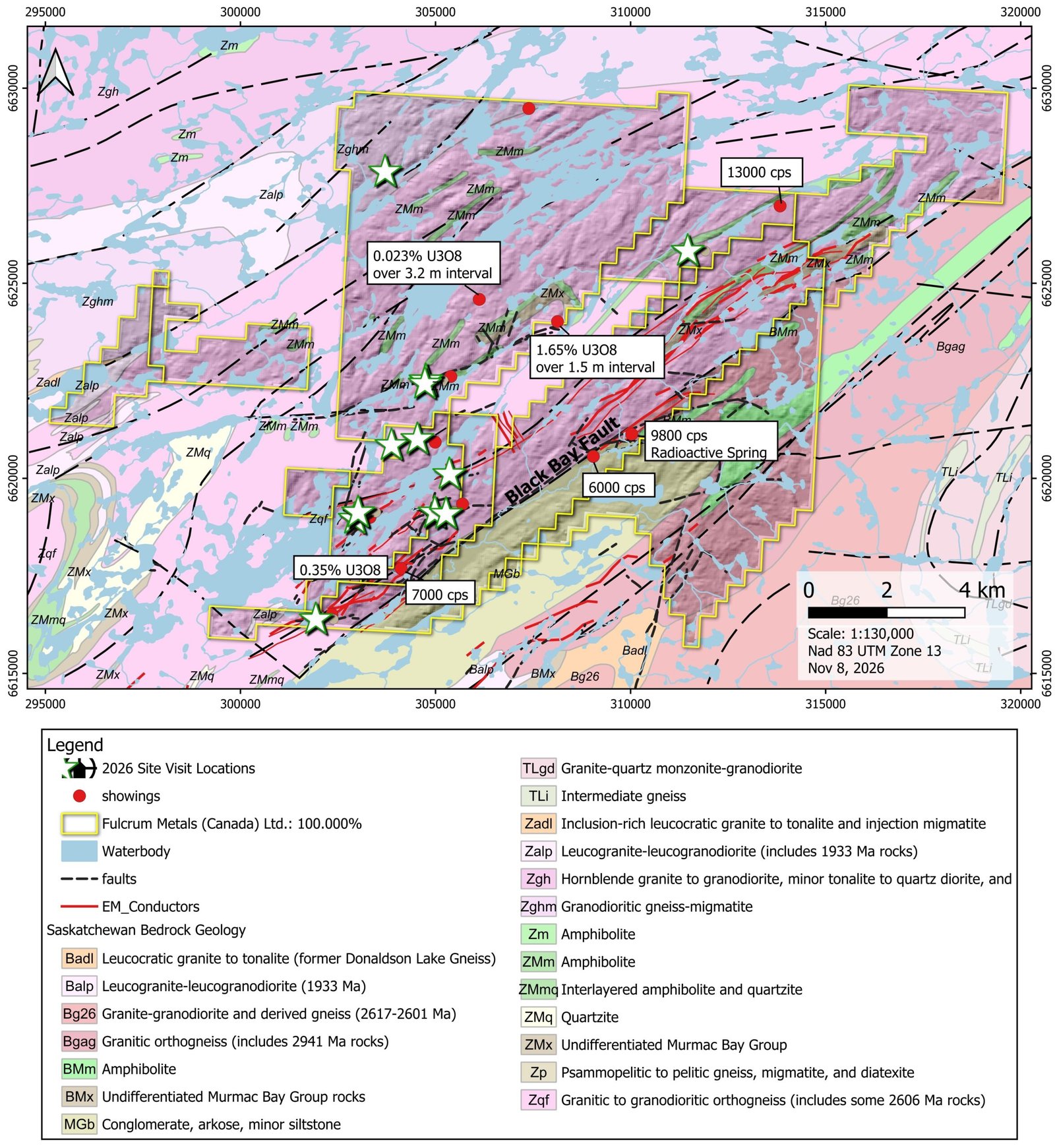
Figure 1. Lithostratigraphic map of the 163 km2 Charlot-Neely Lake project area north of Uranium City, Saskatchewan with principal tectonic domains, structural components of the Black Bay fault, the previously identified EM conductors that are dominated by graphite or graphitic schist, and historical showings of anomalous radioactivity. White stars are field locations where measurements and sample shave been taken in October of 2026.
Charlot-Neely Lake Anomalies
The so-called Bullseye zone sits between western sections of Charlot and Neely lakes (NW of Bert uranium showing) and was initially identified as a prominent, “Grade-1” radiometric anomaly during Terra’s airborne radiometric survey. It is a 300 m long, ENE-WSW trending zone of pinkish, K-feldspar, muscovite leucogranite dykes and biotite orthogneiss crosscut by quartz veins and aplites. Multiped blast pits were located with scintillometer measurements of up to 17,291 counts per second (“cps”). One-inch diameter drill core remains were also located between the blast pits 2 and 3 with mineralized intervals clearly extracted and assayed (Figure 2).
The Peacock uranium showing is a rusty coloured and oxidized blast pit area with up to 37,265 total cps located at the northeaster end of the linear radioactivity zone that terminates with the Bullseye zone to the southwest. The lithology is characterized by medium grained, quartz syenitic dyke trending at 083°/032° that crosscuts biotite-amphibole granitic orthogneiss. (Figure 3). This showing is clearly fault-controlled with highest readings obtained at structurally emplaced dyke margins.
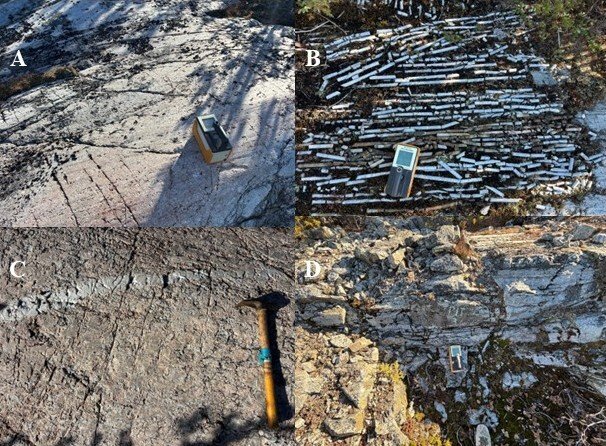
Figure 2. “Bullseye zone” showing northwest of Bert uranium showing was characterized by significantly anomalous readings yielded by the airborne radiometric survey from September 2026. The wider area was previously explored as evidenced by core drilling and blast pits shown in b) and d) above.
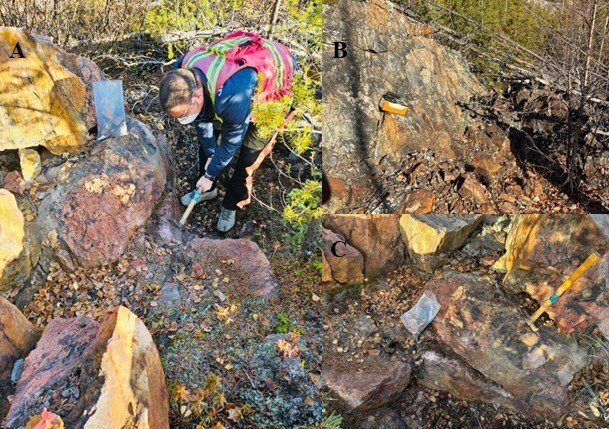
Figure 3. The Peacock uranium showing featured a blast pit in b) carved into NE-SW trending fault zone that was crosscut by up to 3 m wide syenitic dyke with intense FeOx staining seen in c) above.
Up to 8,320 cps were measured south of the RA-2 showing (SMDI #1337) that is located 610 m east of the most southerly point of Neely Lake. Here, 0.6 cm calcite veins exhibit yellow stains, and the area is underlain by northeast-trending orthoquartzite. The veins occur as lenses of granite in orthoquartzite within a contact between the orthoquartzite and amphibolite, to the east. The regional geology consists of northeast-trending granitic gneiss and mylonites of the Tazin group, commonly containing lenses or bands of amphibolite, biotite, or chlorite (Figure 4).
At the northern part of the Charlot Neely Lake claim cluster sits the Gatzke Lake showing with up to ca. 4,500 count per second measured on site. It is adjacent to the Don Henry uranium occurrence, a legacy site from the 1950s uranium boom in the Beaverlodge district. The uranium mineralization in this area is basement-hosted and structurally controlled, occurring as pitchblende in fractures and veins within high-grade Tazin Group metamorphics.
A “Grade-1” airborne anomaly east of the northern segment of Charlot Lake features pinkish, leucogranite dykes with up to 16,699 total cps measured on site. It is located 2.1 km southwest of the MK Claim No. 5, a fault-controlled uranium showing near Mickey Lake (SMDI #1305).
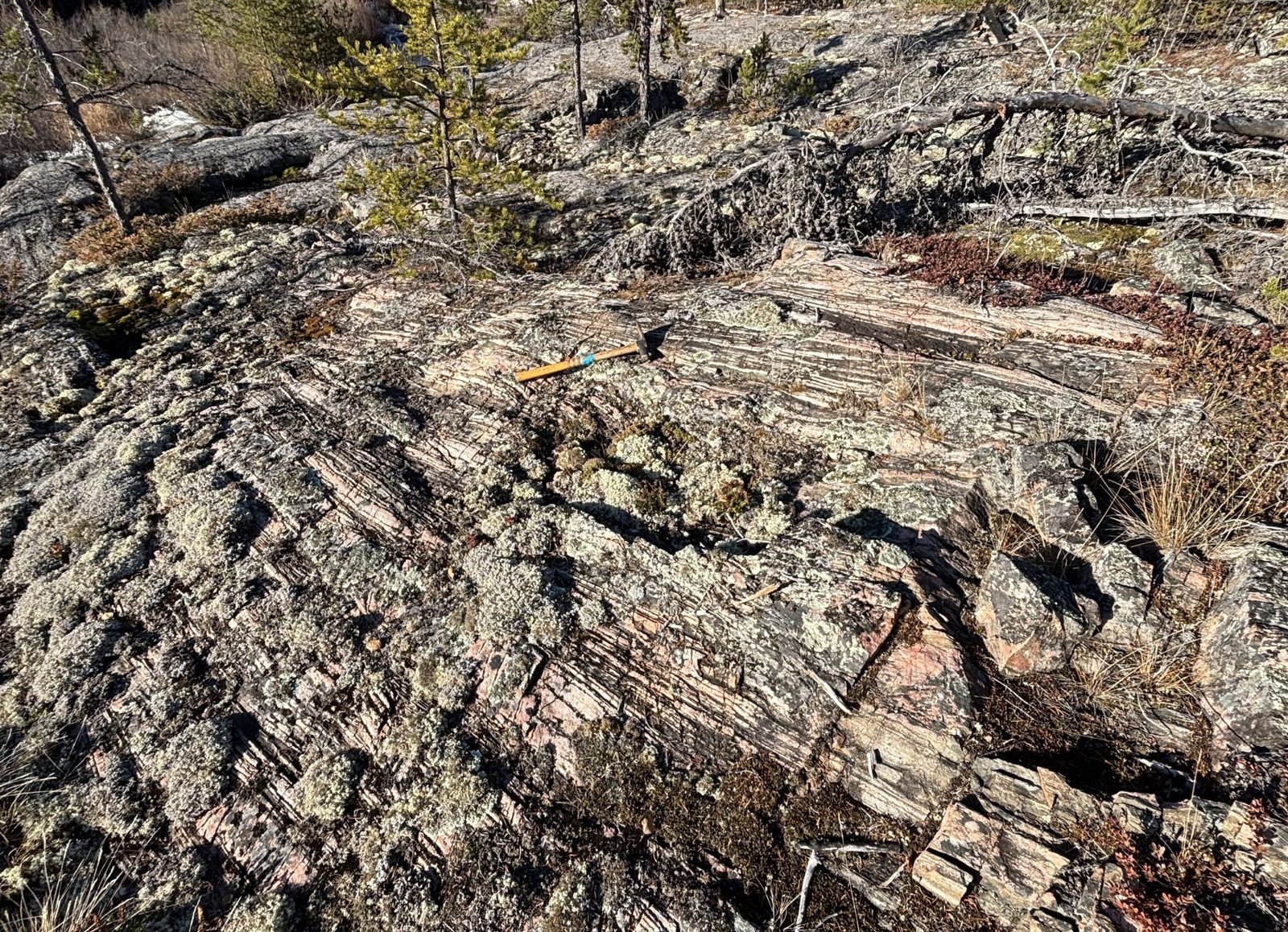
Figure 4. Zone south of the historic RA-2 uranium showing is dominated by banded amphibolite, biotite, or chlorite mylonite aligned NE-SW with the direction of Black Bay fault movement.
The Emir Fault zone uranium showing is catalogued alongside other local radioactive occurrences in the southern Charlot Neely Lake area, including the Papik Lake showing, Eke Lake uranium deposit, the Fredette Lake ore shoots, and the Pinky Lake Fault Zone showing.
Like most deposits in the Beaverlodge area, mineralization is structurally controlled by regional fault and fracture systems. Repeated reactivations along Emir Fault likely created brittle breccia zones and fractures that functioned as conduits for uranium-bearing hydrothermal fluids. Uranium-bearing minerals are accompanied by minor iron or base-metal sulphides typical of Beaverlodge-style vein systems.
It is an epigenetic, vein- and breccia-hosted uranium locality with pitchblende-bearing fault trace cutting through Archean and Paleoproterozoic basement gneisses and metasediments. Locally, there are traces of sodic metasomatism (albitization) and hematite alteration along fault zones. Scintillometer measurements yielded up to 31,258 total cps (Figure 5).
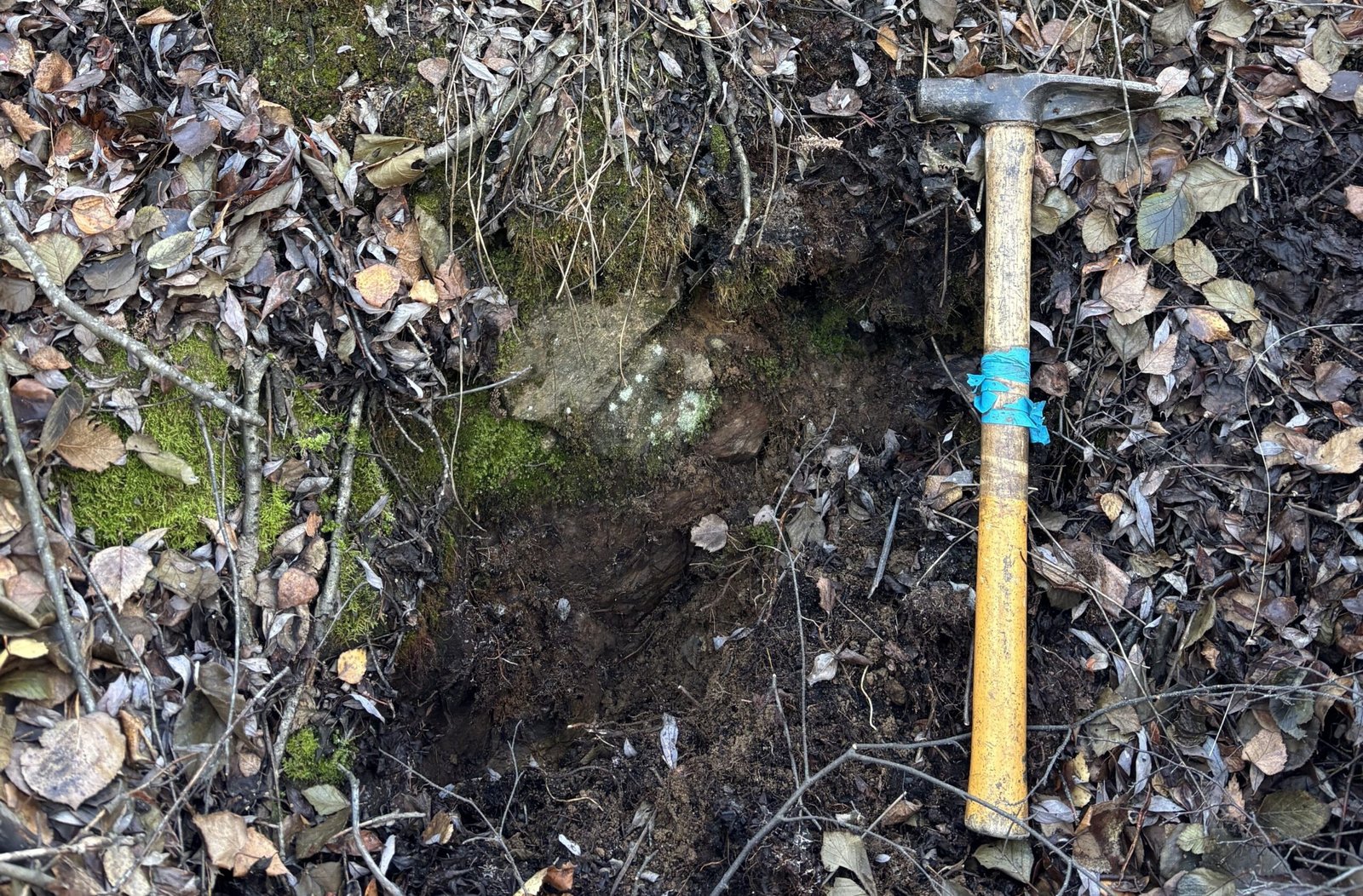
Figure 5. Emir fault zone.
Techniques
Field measurements were conducted using the handheld, multichannel Exploranium GR-135 Plus “Identifier” radioisotope analyser designed to quickly detect and identify gamma and neutron radiation sources. It combines a high-resolution Sodium Iodide (NaI(Tl)) gamma-ray spectrometer, a high-range Geiger-Müller (GM) tube for high dose rates as well as a Helium-3 (He3) neutron detector. The instrument operated across an energy spectrum of 20 keV to 3.0 MeV with a 1,024-channel analyser capable of sorting and identifying up to 23 radionuclides. Algorithmic correction was applied including thermal gain stabilization and pulse pile-up rejection to ensure accuracy and prevent errors under high radiation counts. Energy channels and system functionality were tuned twice daily using sealed-disc, Cesium-137 (137Cs) standard reference material (01-2006) by Science Applications International Corporation (SAIC) with nominal activity of 0.25 μCi emitting a distinct 662 keV gamma-ray line to provide baseline for energy calibration and detector resolution. The stated uncertainty of the SRM is ± 15%.
Qualified Person
Dr. Aleksandar Mišković, P.Geo, is the Company’s CEO and designated Qualified Person within the meaning of National Instrument 43-101 Standards of Disclosure of Mineral Projects (“NI 43-101”). Dr. Mišković has prepared this news release and validated that the information contained within is factual and accurate.
About the Company
Terra Balcanica is a polymetallic exploration company targeting large-scale mineral systems in southeastern Europe. The Company has 100% interest in the Viogor Project in eastern Bosnia and Herzegovina. Terra holds a 34.7% ownership in Terra North Resources Corp. and its Canadian assets that comprise a 100% optioned portfolio surrounding the world-renowned Athabasca basin. The Company emphasizes responsible engagement with local communities and stakeholders. It is committed to proactively implementing Good International Industry Practice (GIIP) and sustainable health, safety, and environmental management.
On Behalf of the Board of Directors
Terra Balcanica Resources Corp.
“Aleksandar Mišković”
Aleksandar Mišković
President and CEO
For further information, please contact Aleksandar Mišković at amiskovic@terrabresources.com, +1 (514) 796-7577, or visit our website at www.terrabresources.com/en/news.
Cautionary Statement
This news release contains certain forward-looking information and forward-looking statements within the meaning of applicable securities legislation (collectively “forward-looking statements”). The use of any of the words “will”, “intends” and similar expressions are intended to identify forward-looking statements. These statements involve known and unknown risks, uncertainties and other factors that may cause actual results or events to differ materially from those anticipated in such forward-looking statements. Such forward-looking statements should not be unduly relied upon. Actual results achieved may vary from the information provided herein as a result of numerous known and unknown risks and uncertainties and other factors. The Company believes the expectations reflected in those forward-looking statements are reasonable, but no assurance can be given that these expectations will prove to be correct. The Company does not undertake to update these forward-looking statements, except as required by law.